The Next Revolution in Ophthalmology Is Already Underway
For more than a century, contact lenses have primarily served one purpose: correcting vision.
That is changing rapidly.
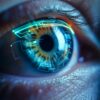
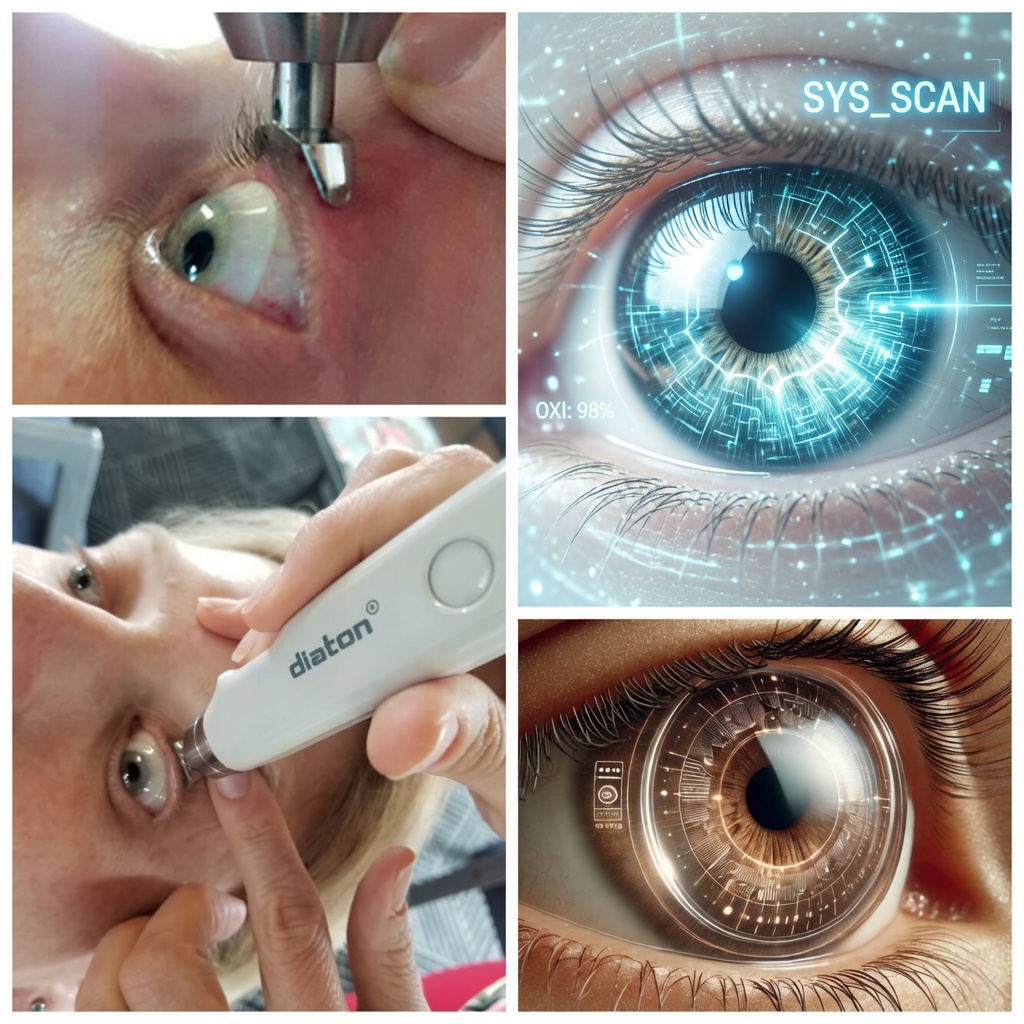
Today’s ophthalmology industry is entering an era of wearable eye technology. Researchers, universities, startups, and global medical device companies are developing increasingly sophisticated ocular platforms capable of far more than refractive correction. Smart contact lenses, drug-delivery systems, biosensing wearables, augmented reality optics, and continuous physiological monitoring devices are moving from research laboratories toward clinical practice.
Industry publications now routinely describe the eye as an emerging platform for diagnostics, digital health, and personalized therapy.
This transformation represents one of the most exciting periods in the history of eye care.
Yet it also raises an important clinical question that receives surprisingly little attention:
How should clinicians monitor intraocular pressure (IOP) while these technologies remain on the eye?
Innovation Does Not End with the Device
Every breakthrough in ophthalmology follows a familiar path.
First comes innovation.
Then comes clinical validation.
Finally comes long-term patient monitoring.
Building a sophisticated ocular wearable is only one part of the journey.
Researchers must also answer essential questions:
- Does prolonged wear influence intraocular pressure?
- Does device fit remain stable over time?
- How does the eye respond after weeks or months of continuous wear?
- Are glaucoma patients appropriate candidates?
- Does the device alter ocular physiology in ways that require monitoring?
These questions are not unique to smart contact lenses.
They apply equally to therapeutic scleral lenses, sustained drug-delivery platforms, biosensing contact lenses, and future ophthalmic technologies still under development.
The Wearable Eye Creates a New Monitoring Challenge
Historically, most tonometry methods assumed direct access to the cornea.
For decades, this assumption made perfect sense.
Today’s ocular technologies are changing that assumption.
The corneal surface is becoming increasingly occupied by devices designed to remain in place rather than be removed during routine examinations.
Examples include:
- therapeutic scleral lenses
- extended-wear bandage lenses
- smart contact lenses
- drug-delivery lenses
- glucose-sensing contact lenses
- augmented reality contact lenses
- biosensing ocular wearables
As the corneal surface becomes increasingly occupied, clinicians may increasingly ask:
Can we evaluate the eye without interrupting the technology we are trying to assess?
Emerging Research Highlights the Importance of Monitoring During Wear
Recent clinical research suggests this question is becoming increasingly relevant.
A 2026 prospective crossover study by Dhungel et al. https://www.mdpi.com/2075-1729/16/7/1094 evaluated intraocular pressure during scleral lens wear and reported a statistically significant increase in IOP during lens wear in the healthy participants studied, with pressures returning toward baseline after lens removal. The investigators also observed transient retinal nerve fiber layer changes and recommended additional research in glaucoma and ocular hypertension populations.
These findings should not be interpreted as evidence that scleral lenses are unsafe.
Rather, they reinforce a broader principle:
When technology remains on the eye, clinicians may benefit from evaluating ocular physiology while that technology remains in its intended clinical environment.
The Missing Piece: Monitoring Infrastructure
Innovation in wearable ophthalmology has focused primarily on what the lens can accomplish.
Sensors.
Drug delivery.
Artificial intelligence.
Augmented reality.
Continuous biomarker monitoring.
These advances are remarkable.
Equally important, however, is developing practical methods for monitoring the eye itself throughout the lifecycle of these technologies.
Every new ocular platform requires:
- laboratory evaluation
- clinical trials
- regulatory review
- physician fitting
- long-term follow-up
- post-market surveillance
Throughout each stage, clinicians must continue assessing the health of the eye—including intraocular pressure.
Diagnostic strategies should evolve alongside therapeutic innovation.
A Corneal-Independent Measurement Pathway
One approach to this challenge is corneal-independent tonometry.
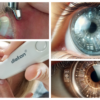
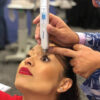
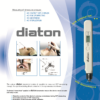
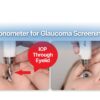
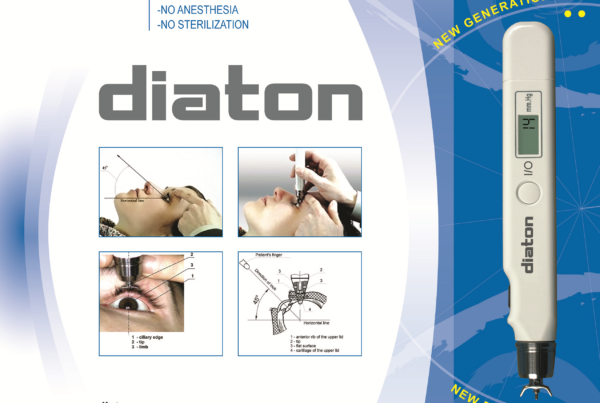
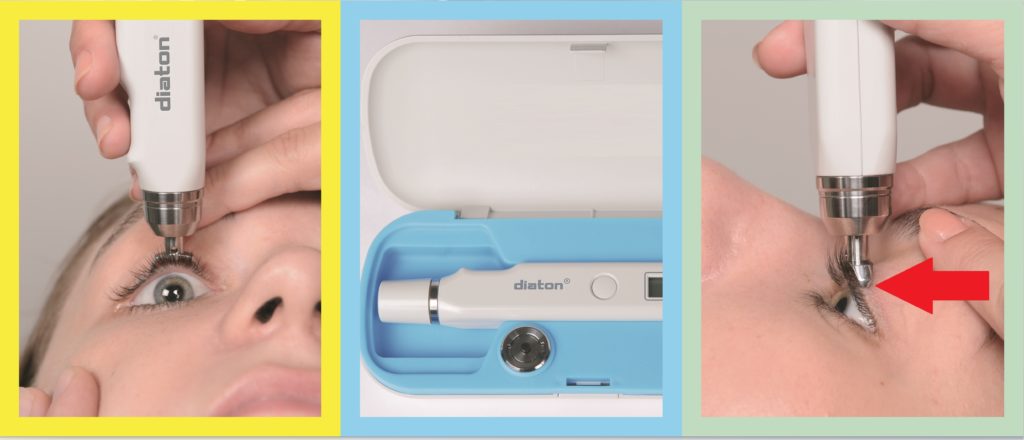
The Diaton® transpalpebral scleral tonometer measures intraocular pressure through the upper eyelid over the sclera, rather than through the cornea.
With proper technique, the upper eyelid is gently elevated so its margin clears the superior limbus—or the upper edge of a contact or scleral lens—while the Diaton tip is positioned centrally on the upper eyelid over the tarsal plate, aligned with the pupil.
The cornea remains untouched.
The ocular device remains in place.
The measurement pathway remains independent of the corneal surface.
This creates an opportunity to assess IOP without disrupting many therapeutic or investigational ocular devices.
Beyond Clinical Practice
The implications extend well beyond routine patient care.
Future ophthalmic innovation will increasingly involve collaboration among:
- ophthalmologists
- optometrists
- biomedical engineers
- contact lens manufacturers
- pharmaceutical companies
- university researchers
- regulatory agencies
- clinical trial investigators
Each group shares a common goal:
Develop technologies that improve vision while preserving ocular health.
Corneal-independent tonometry may become one complementary tool supporting research, safety evaluation, and long-term monitoring across this expanding ecosystem.
Looking Beyond Today’s Technology
Today’s smart contact lenses represent only the beginning.
Future ocular technologies may include:
- AI-assisted contact lenses
- advanced biosensors
- sustained therapeutic delivery systems
- personalized digital vision platforms
- implantable ocular electronics
- adaptive visual enhancement devices
As these innovations mature, clinicians will require diagnostic methods capable of evaluating the eye without unnecessarily interrupting the technology itself.
Rather than viewing corneal-independent tonometry simply as another method of measuring IOP, it may be more appropriate to view it as part of the diagnostic infrastructure supporting the future of wearable ophthalmology.
The Future of Eye Pressure Monitoring
Every major advance in medicine eventually reshapes the tools surrounding it.
Wearable ophthalmology is no different.
The next generation of ocular technology will require equally sophisticated approaches to monitoring safety, physiology, and long-term outcomes.
The future of eye care is not defined only by smarter contact lenses.
It is also defined by smarter ways of understanding the eye while those technologies remain in place.
That future may begin beyond the cornea.
Frequently Asked Questions
Why measure IOP while a contact lens remains on the eye?
In some clinical and research settings, measuring IOP during actual device wear may provide useful information about how the eye responds while the technology is functioning, rather than only after removal.
Can the Diaton tonometer measure through a contact lens?
The Diaton does not measure through the contact lens. It measures through the upper eyelid over the sclera, while the contact or scleral lens remains on the cornea.
Why is corneal-independent tonometry relevant to smart contact lenses?
Future ocular wearables are designed to remain on the eye for extended periods. A measurement pathway that does not require direct corneal access may complement research and clinical monitoring as these technologies evolve.
Is corneal-independent tonometry intended to replace Goldmann applanation tonometry?
No. Goldmann applanation tonometry remains an important clinical reference method. Corneal-independent tonometry provides an additional approach that may be particularly useful in selected clinical situations where maintaining the ocular device or avoiding corneal contact is desirable.
Conclusion
The evolution of smart contact lenses, therapeutic ocular wearables, and digital eye technologies is transforming ophthalmology.
As these innovations become part of routine clinical care, the conversation must expand beyond what these devices can do to include how clinicians will safely monitor the eyes wearing them.
Corneal-independent IOP assessment represents one complementary approach to meeting that challenge.
The future of ophthalmology will be shaped not only by innovation on the corneal surface, but also by the diagnostic pathways that allow clinicians to evaluate the eye beyond it.
Learn more about Diaton Tonometer:
- Diaton product page
- 100 Questions and Answers on Diaton
- How to use the Diaton Tonometer technique
- Diaton in post-LASIK / corneal pathology
- Diaton in emergency medicine / broader screening environments
- Glaucoma screening / glaucoma awareness
- Dhungel P, Alanazi MK, Caroline P, Yudcovitch L, Liu M. Short-Term Impact of Scleral Lens Wear on Intraocular Pressure and Retinal Nerve Fiber Layer Thickness. Life. 2026; 16(7):1094. https://doi.org/10.3390/life16071094
Learn more about Diaton Scleral Translpalpebral Tonometer – www.TonometerDiaton.com
Contact Team Diaton via Phone: 1-877-342-8667