Part 1 of the Emergency Eye Care Series
When Every Minute Matters
A patient arrives in the Emergency Department complaining of severe eye pain.
Their vision is blurred.
Their eye is red.
They describe halos around lights.
They are nauseated.
For the emergency physician, one diagnosis cannot be missed:
Acute Angle-Closure Glaucoma.
Although relatively uncommon, acute angle-closure glaucoma is one of ophthalmology’s true emergencies. Rapid elevation of intraocular pressure (IOP) may threaten permanent vision if diagnosis and treatment are delayed.
Emergency clinicians are not expected to perform a comprehensive glaucoma workup. Their responsibility is to recognize potentially vision-threatening conditions, rapidly assess the patient, begin appropriate management, and obtain urgent ophthalmology consultation when indicated.
An eye pressure measurement is often an important part of that evaluation.
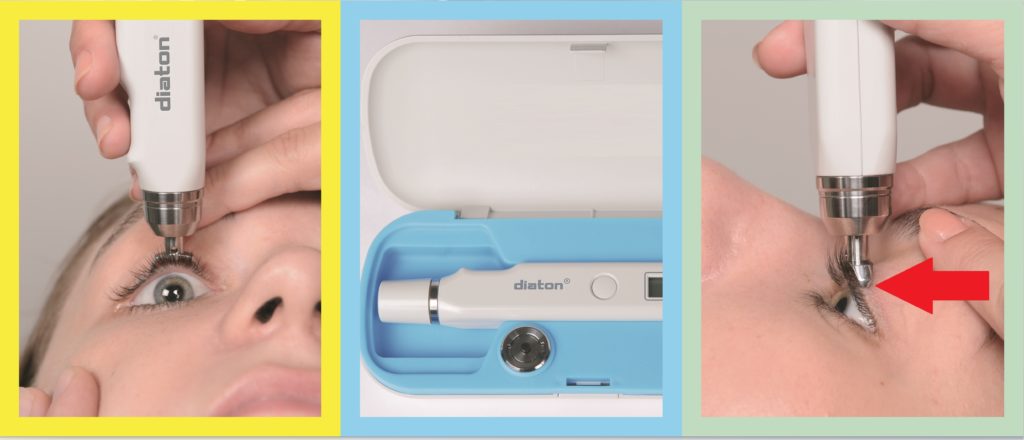
This is where the Diaton® Tonometer has found a unique role in hospitals, emergency departments, emergency rooms, and urgent care clinics around the world.
Emergency Departments Need More Than Accuracy
Emergency departments operate differently than ophthalmology clinics.
When evaluating equipment, clinicians and hospital administrators consider more than clinical performance alone.
They also think about:
- Is it ready when I need it?
- Can I take it directly to the patient?
- Is it simple to disinfect?
- Does it require disposable supplies?
- Will staff actually use it?
- How much ongoing maintenance does it require?
These operational realities are often just as important as the measurement itself.
Diaton was designed with these real-world challenges in mind.
Emergency Department Ready™
Built for the Realities of Emergency Medicine
1. Ready to Use
One of the most common frustrations emergency physicians have expressed over the years is the need to perform routine calibration procedures before using some handheld tonometers.
When every minute matters, clinicians want equipment that is immediately available.
With Diaton, there is no routine user calibration required before measurement, allowing clinicians to retrieve the device and proceed with the examination following proper technique and the manufacturer’s Instructions for Use.
2. Handheld. Portable. Goes Where the Patient Is.
Patients are not always in an examination room.
They may be:
- Trauma Bay
- Observation Unit
- ICU
- Hospital Ward
- Fast Track
- Pediatric Emergency
- Bedside
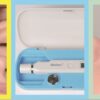
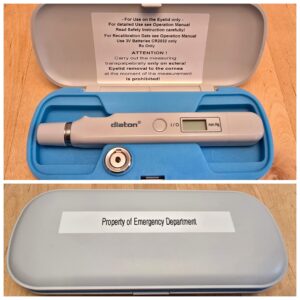
Diaton is lightweight, handheld, battery operated, and portable.
Instead of bringing the patient to the equipment, the equipment goes to the patient.
From room to room, bay to bay, and bedside to bedside, Diaton is designed to move with the clinical team.
3. Simplified Workflow
Every additional step slows patient care.
Unlike many traditional approaches to tonometry, Diaton requires:
- No anesthetic eye drops
- No fluorescein
- No disposable tips
- No disposable probe covers
- No charging dock
With fewer supplies to locate and fewer preparation steps, clinicians can focus on the patient instead of the equipment.
4. Infection Prevention
Infection prevention remains a priority throughout healthcare.
The Diaton Tonometer supports efficient infection-control workflows by eliminating the need for disposable plastic tips and probe covers.
Following the manufacturer’s Instructions for Use and your facility’s infection-control policies, the entire external device, including the measurement tip, can be disinfected between patients using an approved alcohol wipe or alcohol swab.
Benefits include:
- No disposable plastic tips
- No disposable probe covers
- Entire device easily disinfected
- Reduced medical waste
- Simplified cleaning between patients
- Lower ongoing consumable costs
For busy emergency departments, fewer supplies often means fewer workflow interruptions.
5. Corneal-Independent Measurement
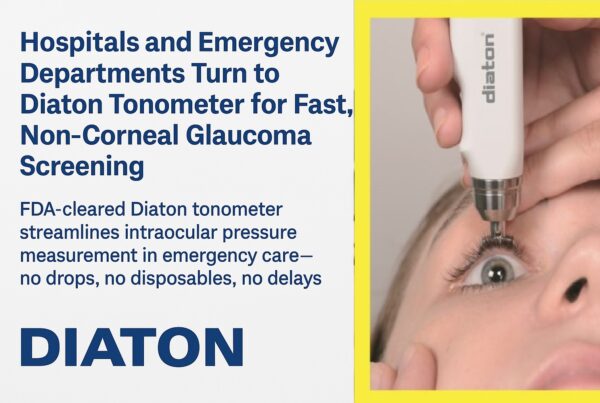
Unlike conventional tonometers that measure through direct corneal contact, Diaton measures intraocular pressure through the upper eyelid over the scleral area.
This corneal-independent approach may be particularly valuable in patients with:
- Previous LASIK or refractive surgery
- Corneal scars
- Corneal edema
- Keratoconus
- Corneal irregularities
- Severe dry eye
- Scleral lenses
- Other situations where direct corneal measurement is less desirable
Because the measurement does not rely on the cornea, pachymetry is not required for the Diaton measurement itself.
6. Lower Total Cost of Ownership
Hospital administrators evaluate much more than purchase price.
They consider:
- Consumables
- Inventory
- Maintenance
- Staff training
- Downtime
- Medical waste
- Workflow efficiency
Diaton helps reduce ongoing operational complexity because it requires:
- No disposable measurement tips
- No disposable probe covers
- No anesthetic drops
- No fluorescein
- No charging dock
- No routine user calibration before measurement
The result is a device designed to simplify ownership as well as clinical use.
How Diaton Fits Into the Emergency Department Workflow
Emergency medicine is built around rapid assessment and timely referral.
A typical workflow may include:
Patient presents with eye pain or visual symptoms
↓
Clinical history and examination
↓
Eye pressure assessment using Diaton
↓
If clinically indicated:
Urgent ophthalmology consultation and further evaluation
Diaton is not intended to replace comprehensive ophthalmic examination or every method of tonometry.
It provides clinicians with another practical option for obtaining an eye pressure measurement as part of the overall emergency assessment.
Patient Comfort
Patients presenting with painful eye conditions are often anxious about anything touching the eye.
Many appreciate that Diaton:
- Does not touch the cornea
- Requires no anesthetic drops
- Is quick
- Is comfortable
- Is non-invasive
A positive patient experience benefits both patients and healthcare providers.
Why Emergency Departments Choose Diaton
Emergency Department Ready™
✔ Ready to use
✔ No routine user calibration before measurement
✔ Handheld and portable
✔ Room to room
✔ Bay to bay
✔ Bedside to bedside
✔ Battery operated
✔ No charging dock
✔ No anesthetic drops
✔ No fluorescein
✔ No disposable tips
✔ No disposable probe covers
✔ Entire device easily disinfected
✔ Corneal-independent measurement
✔ Comfortable for patients
✔ Lower operating costs
✔ Supports efficient infection-control workflows
✔ Ready when every minute matters
Conclusion
Emergency departments need equipment that is practical, portable, reliable, and immediately available.
The Diaton Tonometer was designed to reduce operational friction by eliminating many of the additional steps associated with conventional eye pressure assessment—including routine user calibration before measurement, anesthetic drops, disposable tips, charging requirements, and direct corneal contact.
For emergency physicians, nurses, hospital administrators, and procurement teams, the value extends beyond measuring intraocular pressure.
It is about readiness.
It is about workflow.
It is about infection prevention.
It is about bringing the device to the patient—from room to room, bay to bay, and bedside to bedside.
Diaton®
Beyond the Cornea™
Emergency Department Ready™

Frequently Asked Questions (FAQ)
Why is eye pressure assessment important in the Emergency Department?
Patients presenting with severe eye pain, blurred vision, headache, red eye, ocular trauma, nausea, or suspected acute glaucoma may require an intraocular pressure assessment as part of their emergency evaluation.
Does the Diaton Tonometer touch the cornea?
No. Diaton measures intraocular pressure through the upper eyelid without direct corneal contact.
Does Diaton require anesthetic eye drops?
No.
Does Diaton require disposable tips or probe covers?
No.
Does Diaton require routine calibration before measurement?
No routine user calibration is required before measurement. Users should always follow the manufacturer’s Instructions for Use.
Can the entire device be disinfected?
Yes. Following the manufacturer’s Instructions for Use and your facility’s infection-control protocols, the entire external device, including the measurement tip, can be disinfected using an approved alcohol wipe or alcohol swab.
Does Diaton require charging?
No. Diaton is battery operated and does not require a charging dock.
Does Diaton require pachymetry?
No. Because Diaton provides a corneal-independent measurement, pachymetry is not required for the Diaton measurement itself.
Is Diaton intended to replace Goldmann applanation tonometry?
No. Diaton complements existing methods of tonometry by providing another practical option in appropriate clinical settings.