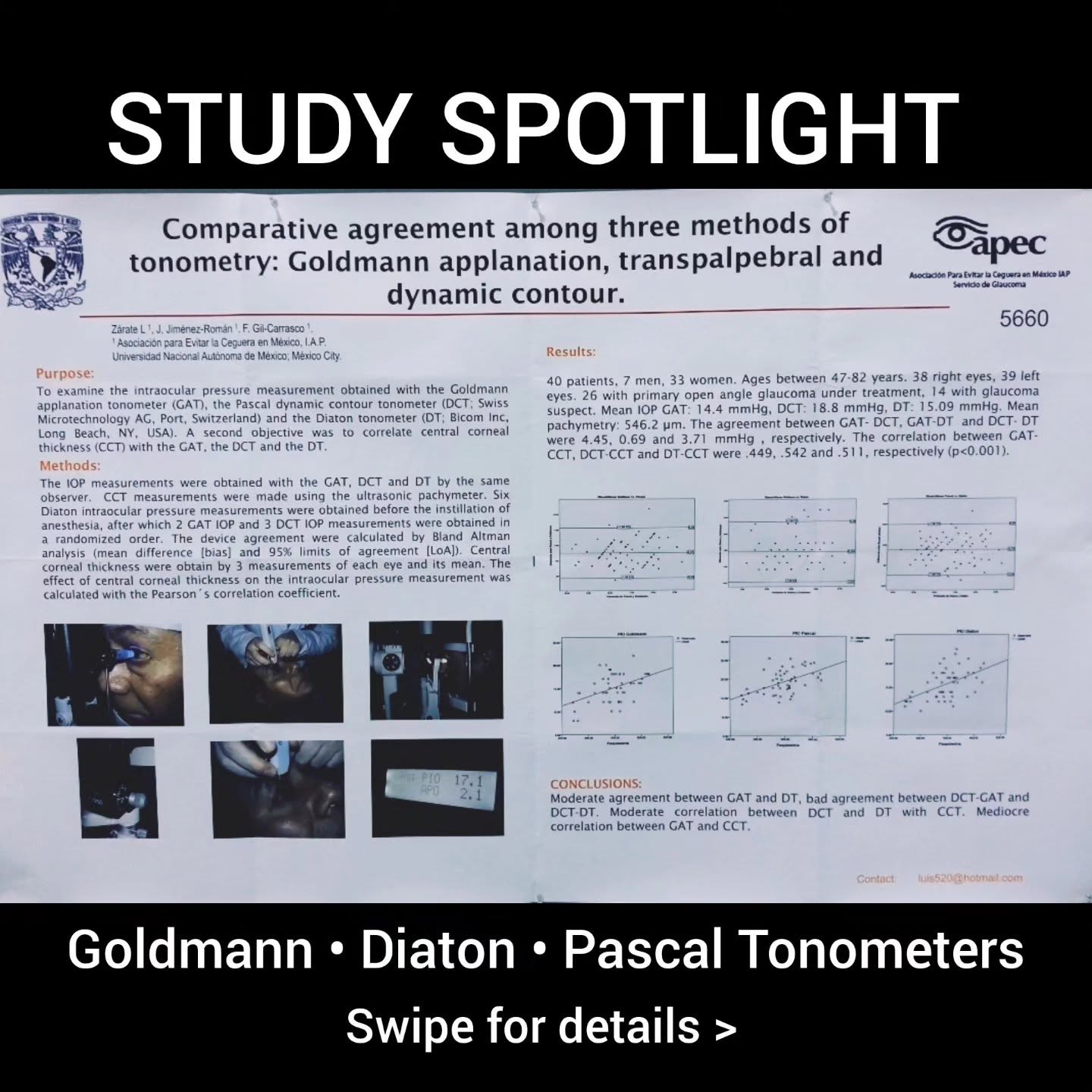
Clinical comparative tonometry study — Goldmann Applanation (GAT) vs. Pascal Dynamic Contour (DCT) vs. Diaton Transpalpebral (DT)
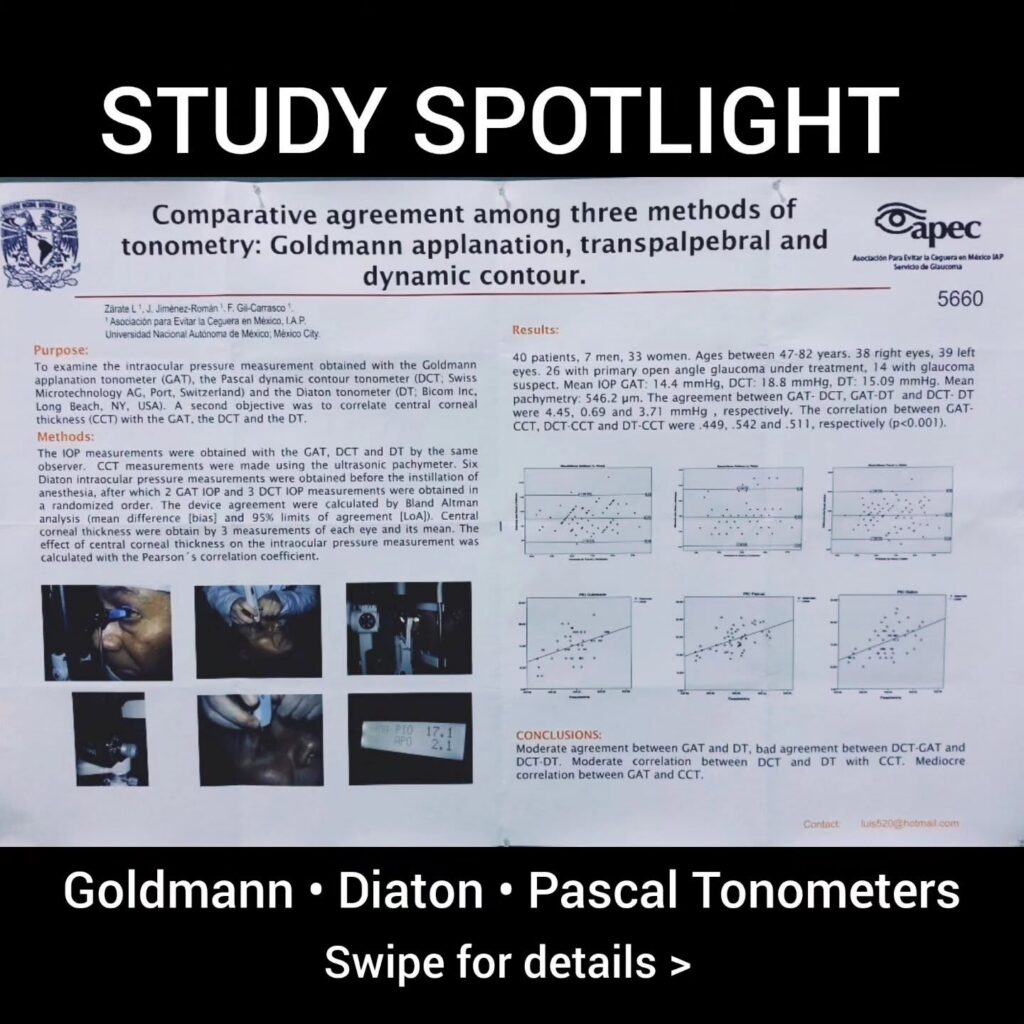
Zárate, Jiménez-Román, Gil-Carrasco — Asociación Para Evitar la Ceguera en México (APEC) / UNAM
 77 eyes, 40 patients with glaucoma or glaucoma suspicion
Mean IOP:
GAT: 14.4 mmHg
DCT: 18.8 mmHg
Diaton: 15.1 mmHg
Agreement with Goldmann:
Diaton: 0.69 mmHg average difference
DCT: 4.45 mmHg average difference
Diaton tracked closely with the clinical reference standard in this study — even more closely than a device specifically engineered for corneal independence. A meaningful data point supporting corneal-independent tonometry as a reliable option in real glaucoma patients.
COMPARATIVE AGREEMENT AMONG THREE METHODS OF TONOMETRY: GOLDMANN APPLANATION, TRANSPALPEBRAL, AND DYNAMIC CONTOUR
LUIS ZARATE, Magdalena García-Huerta, Rafael Castañeda Diez, Mauricio Turati, Felix Gil Carrasco, Jesus Jimenez-Roman, Jose Paczka; COMPARATIVE AGREEMENT AMONG THREE METHODS OF TONOMETRY: GOLDMANN APPLANATION, TRANSPALPEBRAL, AND DYNAMIC CONTOUR. Invest. Ophthalmol. Vis. Sci. 2013;54(15):5660.
https://iovs.arvojournals.org/article.aspx?articleid=2150631
Abstract
Purpose: To investigate agreement of intraocular pressure (IOP) as measured by the Goldmann applanation tonometer (GAT), the Pascal dynamic contour tonometer (DCT), and Diaton transpalpebral tonometer (DTT).
Methods: Device agreement was calculated by Bland-Altman analysis in 77 eyes of 40 individuals (mean age 58.9 ± 13 years) with a mixed diagnosis of glaucoma suspicion and primary open-angle glaucoma. All measurements were performed in a random order by the same clinician according to standard procedures.
Results: Mean IOPs ± S.D. were 14.4 ± 2.9 mm Hg (GAT), 18.8 ± 3.2 mm Hg (DCT; P = 0.005, ANOVA), and 15.1 ± 3.1 mm Hg (DTT). Bland-Altman analysis demonstrated that, on average, DCT IOP measurements overestimated in approximately 3 mm Hg, values derived from GAT and DTT, although agreement was fairly good.
Conclusions: All methods of tonometry were adequate to measure IOP in our sample. Agreement among devices was considered good; nevertheless, DCT values of IOP were significantly higher as compared to the other two assessed methods.