Version Española
TRANSPALPEBRAL "DIATON" TONOMETER
OPERATIONAL MANUAL
The present guide is part II of the operation manual (OM) for the
Digital Portable Tonometer of Intraocular Pressure through the Eyelid Diaton and contains data necessary for the correct usage of the tonometer.
All rules and recommendations included in the guide,
developed under the scientific direction of A.P.Nesterov the
Academician of the Russian Academy of the Medical Sciences, should be
studied prior to the operation of Diaton Tonometer.
Diaton Tonometer is protected with Russian,
Japan and the USA patents for invention. It was awarded a Gold medal at
the World Salon of Inventions in Brussels and in Geneva and is
certified in Russia, EC countries, the USA and other countries.
1. General Information
1.1 Ophthalmotonometry is one of the leading methods
used during screening examinations and while examining the patient
suffered from ophthalmohypertension, glaucoma or with suspicion of
glaucoma. Before the first tonometers inventing the
intraocular pressure (IOP) was evaluated approximately using the method
of eye palpation through the upper eyelid. The palpation method is
still widely used in clinical practice. Using this method the skilled
ophthalmologist can evaluate approximately whether the IOP is normal,
increased or decreased, distinguish normotension from hyper- or
hypotension. The palpation method suffers from subjectivism,
uncertainty of results at ophthalmotone moderate change, but at the
same time shows the principal possibility of transpalpebral tonometry.
1.2 The eyeball is a reservoir of the spherical form,
filled with fluid, incompressible contents. IOP is caused by the
influence of the elastic forces, arising in eye coverings while they
are being stretching.
IOP is a dynamic, continuously changing value. They
distinguish its system, rhythmic fluctuations around relatively
constant level and momentary changes of casual character, caused by
changes in the tone of transpalpebral, orbicular muscle and perhaps by
the tone of outer eye muscles. IOP fluctuations depend also on changes
in blood filling of intraocular vessels and on outer pressure on the
eyeball.
There are 3 types of rhythmic IOP fluctuations around the level:
- Eye pulse with amplitude from 0,5 to 2,5 mm Hg,
- Respiratory waves ( from 0 to 1 mm Hg),
- Hering-Traube waves or the waves of the third order (from 0 to 2,5 mm Hg).
The rhythmic fluctuations of blood filling and
casual changes of the muscle tone explain difference between results of
IOP successive measurings during tonometry. Statistically normal IOP varies from 9 to 21 mm Hg
(on average 15-16 mm Hg). This value has daily and seasonal
fluctuations. The IOP distribution in the normal population is
asymmetrical and is splayed to higher readings. In middle age the
distribution asymmetry increased. More than 3% of healthy persons have
IOP above 21 mm Hg. The ophthalmotone measuring accuracy in the area of
the normal and reasonably increased IOP is especially important for a
practical doctor. 1.3 The Digital Portable Tonometer of Intraocular Pressure through the Eyelid Diaton
is considered to be a transpalpebral tonometer, in which the ballistic
principle of tonometry based on the measuring of the eye elastic
reaction during the momentarily influence on the eye covering of the
free falling object with the definite weight is used.
1.4 Advantages of ballistic transpalpebral tonometry with Diaton Tonometer.
1.4.1 During the corneal tonometry it is very
difficult to prevent the increasing of orbicular and palpebral muscles
tone at the moment of measuring in reactive patients, that leads to IOP
increasing. The ophthalmotone increasing may be also connected with the
blood pressure increasing during the tonometer's bringing near the open
eye. Diaton tonometer is out of the patient's field of vision.
1.4.2 It is known that a tear may contain pathogenic
bacteria and viruses such as hepatitis B virus, herpes, adenoviruses,
AIDS. But the problem of tonometers sterilization is far from
perfection. During tonometry with Diaton device the direct contact with the eyeball is excluded.
1.4.3 The corneal tonometry is contraindicative in conjunctivitis, erosions, sores, hypostasis and cornea dimness. Using Diaton Tonometer the IOP measuring in most of such cases is possible.
1.4.4 The corneal tonometry is impossible without
prior anesthesia, which often causes conjunctiva irritation, short-term
IOP increasing, hypostasis and loosening of cornea epithelium and
sometimes allergic reaction. These undesirable reactions are excluded
while measuring with Diaton tonometer.
2. Assignment
Digital Portable Tonometer of Intraocular Pressure through the Eyelid Diaton
(hereinafter referred as tonometer) is assigned for transpalpebral
measuring of true intraocular pressure in adults and children using no
anesthesia.
3. Mechanism and functioning principal
3.1 Functioning principal
Due to the choose of dynamic (ballistic) method of
dosated mechanical influence to determine the level of intraocular
pressure we managed to avoid the eyelid influence on the tonometry
results. The problem is solved by means of the eyelid pressing on the
area with the diameter of 1,5 mm to such an extend that the pressed
area of the eyelid acts as the transmissive part during the interaction
of the falling rod with the eyelid.
In contrast to applanation tonometry according to
Goldmann the IOP measuring using ballistic method is carried out nearly
instantly. Due to this fact Diaton displays are influenced
mainly by ophthalmotone rhythmic and casual fluctuations. As a rule
these fluctuations do not exceed 2-4 mm Hg in normal or moderately
increased IOP level, which is necessary to consider during the
tonometer's usage. Reliability of IOP measuring with the tonometer is provided
with exact following of the measuring methodology, perfect technique of transpalpebral
tonometry and sufficient practical experience in application (not less than 50 people
during a month).
3.2 Mechanism description
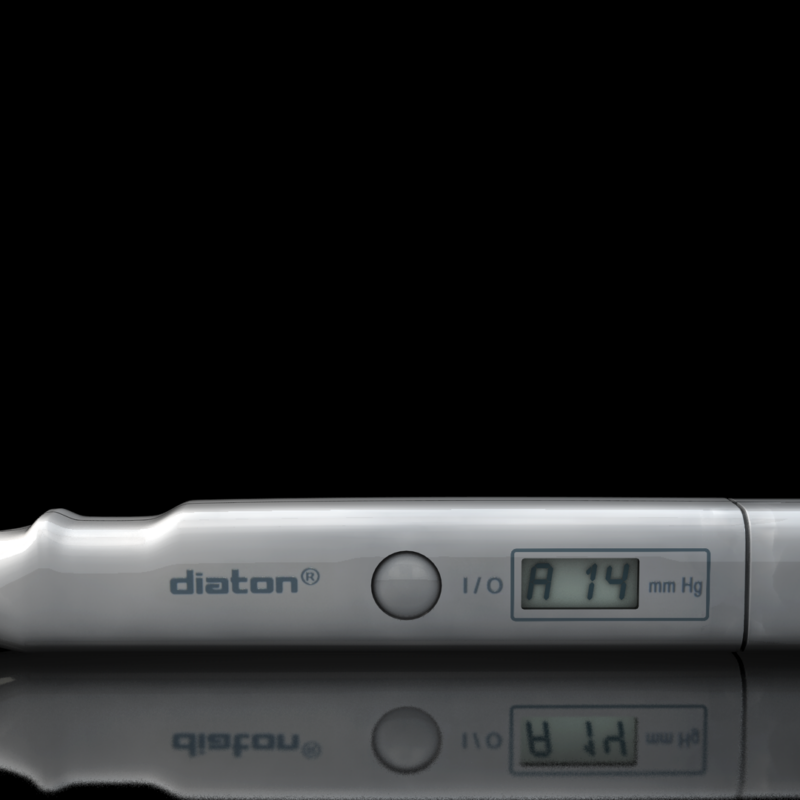
The appearance of the Tonometer is shown in Fig.l.
The Tonometer has a plastic body. The tip is assigned to rest the
Tonometer on the eyeball through the upper eyelid during IOP
measurement. The tip can freely move along the tonometer's axis
relatively its body (up to 3 mm). It provides constant statical load on
the eye during IOP measuring. The tip can be revolved on its axis using
some force.
Figure 1 - the appearance of the tonometer
Figure 2 - the appearance of the tonometer in the case
For greater measuring accuracy the tip is provided with
supports in the form of two protrusions, which helps to eliminate
damping properties of the eyelid as well as to fix the position of the
tonometer in relation to the eyeball during measuring. There is a fluently moving rod inside the
tonometer, which interacts in fall with the elastic surface of the
eyeball through the eyelid. STOP button is assigned to fix the rod inside the tonometer.
The rod's extrication (unfixing) is carried out automatically the tonometer being in
"tip down" position, the device's body being moved relatively to the rod. The rod falls
free.
The OPERATION button on the tonometer's body is designed to control
the tonometer's operating modes:
- tonometer's turning ON and OFF;
- automated receiving of mean IOP result of several measurings (averaging).
The turning of the tonemeter ON is realized by
momentary pressing of the OPERATION button once, the turning OFF - by
pressing of the same button twice, or by pressing the OPERATION button
once, if there were no measurings or the averaging mode was used before
the tonometer's turning OFF. The averaging mode turning ON is realized by pressing of the
OPERATION button once after carrying out of the measuring series from
2 to 6 measurings. The maximum number of measurings in the series is not more that 6.
To carry out the following measuring series it is necessary to turn the
tonometer OFF and then turn it ON again.
The device of the unit's capacity for work control - a pressure selector is built into the tonometer's case (Figure 2).
The tonometry result appears on the display and is
preserved for 30 seconds followed by the tonometer's turning OFF
automatically. The display has 4 digits: the leftmost digit is used for
indication of the auxiliary information, indicated with "U", "L", "H",
"µ", "A" symbols, two rightmost digits are used to indicate the
tonometry results. (Figure 3).
Meanings of the auxiliary information symbols are shown in table 1.
Table 1
| Symbol | Meaning of the symbol |
| "U" | Discharge of the battery |
| "L" | Tonometer's deviation from the vertical line during the measuring for more than 4,5° |
| "H" | The rod mechanism is dirty. "H" symbol is formed the tonometer's position being strictly vertical. |
| "µ" | The end of the series of 6 measurings. |
| "A" | The averaging mode is turned ON. |
"0000" symbol should appear on the display
immediately after turning the tonometer ON. If the symbol is displayed
in the flickering mode it is necessary to put the rod into the initial
position. (point.5.2.5). "U" symbol, displayed in the leftmost
position after turning the tonometer ON or during its work (Figure 4)
shows the battery discharge to the minimum permissible level.
The cap protects the tonometer's rod mechanism from being dirty.
A built-in sound indicator of
position (signaling indicator) helps to control
the vertical position of the tonometer directly
before or during measuring. Keeping the device
in vertical position during tonometry provides
optimal characteristics of the rod movement
that increases measuring accuracy. An
interrupted sound signal before measuring indicates
the device's deviation from the vertical line
for more than 4,5°, at that the frequency of
the sound signals increases the tonometer being
moved closer to the vertical line. Lack of
the sound signal indicates that it is possible
to carry out the measuring the device being
in vertical position. The sound indication turns
off when the tonometer's deviation from the
vertical line is more than 45° (including
the device's horizontal position)..
|
Figure 3 - Indication of the mean measuring value
|
Figure 4 - Indication of the battery discharge
|
Description and meaning of all tonometer's sound signals are shown in table 2.
Table 2
| Description of the sound signal | Meaning of the sound signal |
| Single short signal | 1) Tonometer's turning On or OFF. 2) End of the single measuring (after the falling of the rod) |
| Interrupted signal | Position
indicator signal (tonometer's deviation from the vertical line before
the measuring at the angle more than 4,5°, but less than 45°) |
| Single long signal | Permission to turn ON the averaging mode to get the reliable result. |
| Two long signals | End of the series of 6 measurings. Permission to turn ON the averaging mode. |
While operating the tonometer the attention should be paid to the sound signals and the display information.
4. Operation Restrictions
4.1 Safety instruction
Being operated from low voltage power supply the tonometer is electrically safe.
Measuring of intraocular pressure with the tonometer is permitted only through the eyelid.
4.2 Usage indications
The tonometer's usage indications are the following :
- screening prophylactic mass examinations of the patients;
- IOP control during clinical observation of the patients suffered from glaucoma;
- ortoclinostatical probe, as an additional test during glaucoma
diagnostics and during selection of adequate hypo-tensive therapy;
- ophthalmotone day monitoring (especially at night time);
- IOP measuring during contact correction (lenses are not taken out),
- IOP measuring in immobilized patients;
- IOP measuring in children.
- in the presence in patient of chronical conjunctivitis, cornea
pathology, including keratitis, keratotone, cornea dimness, after
penetrating keratoplastics, keratoprosthesis, laser refractive
correction of the eyesight, high degree of ametropy, astigmatism;
- presence in patient of medicinal allergy;
4.3 Usage contraindications
The tonometer's usage contraindications are the following:
- upper lid pathology (inflammatory diseases, scars, eyelid deformation);
- expressed sclera and/or conjunctiva pathology in the measuring area.
5. Preparation of the tonometer for use
ATTENTION !
If the Tonometer was stored or transported at low
temperatures it should be kept at room temperature not less then three
hours before turning on.
To shorten the time of preparation for work during
the cold season it is recommended to protect the tonometer from cooling
(e.g. hold it in the coat or smock pocket). In such case the time of
keeping the tonometer at room temperature before its turning ON should
be not less than 5 minutes (the case cover must be opened). Then it is
necessary to check its capability for work according to point 5.3.
5.1 Loading the battery
Loading the battery is carried out as the following (Figure 5):
- take the tonometer out of the case;
- remove the cover of the battery compartment slightly pressing it and moving as shown by the arrow (Figure 5a));
- press and hold the OPERATION button;
- insert the battery between lower and upper contact springs with the + terminal upwards (Figure 5b));
- release OPERATION button;
- place the cover in position.
When operating the Tonometer the battery compartment cover should be tightly closed.
Figure 5 a), b)

ATTENTION !
While non-observing the order of the battery loading mentioned above
(e.g., OPERATION button is not pressed before and during the battery loading), the
tonometer may fail to turn on.
In such case it is necessary:
- unload the battery;
- reload the battery not earlier than in 20 minutes strictly
following the loading order mentioned above (while loading the battery
the OPERATION button must be pressed).
5.2 Preparation of the tonometer for measuring
5.2.1 Take the tonometer out of the case, remove the protective cap.
5.2.2 Take the tonometer in hand as it is shown
on Figure 6 a): the thumb is placed on the side of the device's body,
opposite to STOP button, the middle one - on STOP button (do not press
it), the forefinger - above the STOP button, third finger - below the
STOP button, the tonometer's body being turned with its tip downwards.
The tonometer's position does not depend on what hand you are used to work - right or left. The correct position of the tonometer in hand provides the measuring accuracy.
5.2.3 Check the position of the tip supports:
the tip supports must coincide with the level of the tonometer's
exterior side as it is shown on Figure 6 b). Otherwise put the supports
into initial position, revolving the tip on its axis. Watch the tip
position during measurings.
Figure 6. Putting the rod into initial position
5.2.4 Check the position of the rod in the tonometer:
- the rod is inside the tonometer (Figure 6 b)) - the initial position of the rod for a measuring,
- the rod is seen in the tip area (Figure 6 a)) - it is necessary to put it into initial position (point 5.2.5.).
5.2.5 If the rod is seen in the tip area (Figure 6 a)) put the rod into initial position:
- take the tonometer vertically with its tip downwards (points 5.2.2);
- press the STOP button with the middle finger and holding it
move the tonometer fluently with its tip upwards as it shown in Figure
6b). The rod is fixed in initial position;
- return the tonometer fluently without quick movements in the
position with its tip downwards still holding the STOP button. The rod
must be fixed inside the tonometer and not seen in the tip area (Figure
6 b)). Release the STOP button.
ATTENTION !
Because of the incorrect putting of the rod into initial position its fixation may fail.
The most common mistakes:
- pressing of the STOP button before the tonometer is put vertically with its tip downwards (first it is necessary to put the tonometer with its tip downwards and then press the STOP button);
- the STOP button is released before turning the
tonometer in the position with its tip downwards (first it is necessary
to turn the tonometer with its tip upwards holding the STOP button
pressed, then return it into initial position with its tip downwards
and only after that release the STOP button).
5.2.6 If the rod is put into initial position (is fixed inside the
tonometer), press the OPERATION button, holding the tonometer with its tip downwards.
When turning the device on "0000" symbol appears on the display and a short sound signal is heard. The tonometer is ready for work.
If the tonometer is hold with its tip downwards not strictly
vertically, an interrupted sound signal of the tonometer position indicator turns on.
This is an additional information that helps to control the tonometer's vertical
position. The tonometer's position being strictly vertical the sound signal stops.
ATTENTION !
If the rod is not in the initial position then, the device being
turned on, the "0000" symbol is being displayed in a flickering mode.
In this case without turning the tonometer OFF (without pressing the
OPERATION button), it is necessary to put the rod into initial position
(point 5.2.5.). The rod being put into initial position, the flickering
of the "0000" symbol on the display stops. The tonometer is ready for
work. Information of the tonometer's readiness for work ("0000" symbol)
is kept on the display for 30 sec., then the tonometer turns OFF
automatically. In this case, if necessary, turn the tonometer ON,
pressing the OPERATION button momentarily.
If "U" symbol (Figure 4) is displayed after
pressing the OPERATION button it is necessary to turn the tonometer OFF
pressing the OPERATION button momentarily and to change the battery.
(point 5.1). After changing the battery prepare the tonometer for work
(point 5.2).
5.3 Checking of the tonometer's capacity for work
Checking of the tonometer's capacity for work is carried out
once a day before its operation;
- each time before measuring of the patient's IOP while working during cold season not in a stationary conditions;
- if you have doubts in the tonometer's intactness.
5.3.1 Prepare the tonometer for measuring (point. 5.2).
5.3.2. Check the tonometer's displays on the testing device (pressure selector) placed in the case as follows (Figure 7) :
- place the tip supports into the bushing of the testing device (Figure 7 a))
holding the tonometer strictly vertically, (the lack of sound signal indicates the
correct tonometer's position);
- move the tonometer's body fluently down until the rod falls,
which is accompanied with a short sound signal. The result of capacity
for work checking is displayed in two rightmost digits. (Figure 7 b)).
The tonometer is considered operative, if the received
digital measuring result is in the limits of (20 ± 2) mm Hg, and
there are no "L" or "Ѕ" symbols in the display's leftmost digit.
If "L" symbol appears it is necessary to carry out
the checking again (points 5.2.5, 5.3.2), keeping the tonometer
strictly vertically during the checking. If "H" symbol appears or the measuring result
value on the testing device differs from (20 ± 2) mm Hg, the tonometer is
considered inoperative.
The ways of the tonometer's repair are mentioned in point 6 part I of the OM.
5.3.3 Turn the tonometer OFF, momentarily pressing the OPERATION button twice.
The testing device may be used to get the minimum
experience in the device's correct placing, observance of the vertical
position and the tonometer's confident handling that makes for
receiving of more accurate results of IOP measurings in the patients.
Figure 7 (a, b)- Checking of the tonometer's capacity for work
a)
|
b)
|
5.4 Disinfections Procedure
5.4.1 Disinfect the base of the tip and the lower portion of the rod
holding the tonometer with the tip downwards using a sterile piece of cloth
moistened with Veltosept solution. Other ethyl alcohol-based disinfectants non-reactive
with metals may be used. Care should be taken to prevent disinfections solution from
penetrating into the rod mechanism.
After the disinfection is done, wipe the tip and the
lower part of the rod with a dry sterile piece of cloth. Disinfection
of the tip base and the rod should be carried out both before each
patient's tonometry and after. 5.4.2 If necessary disinfection of outer surfaces
(with the exception of the tip and rod) of the tonometer's body is
carried out by using 3% - solution of hydrogen peroxide added with 0.5%
- detergent or by 1% - solution of chloramine.
ATTENTION !
The disinfecting solution is barred from getting inside the tonometer.
It is prohibited to use absorbent cotton or
other fibrous materials, which fibers may get inside the tonometer
while disinfecting the tip's base and the rod.
6. Order of IOP measuring
6.1 Take the tonometer out of the case, remove
the protective cap and disinfect the base of the tip and the lower
portion of the rod according to point 5.4.1.
Prepare the tonometer to carry out the measuring (point 5.2.2.-5.2.6).
6.2 IOP measuring is possible in two patient's positions:
- in a sitting position the patient's head is thrown back horizontally on the head support;
- in the reclining position the patient's head is placed horizontally on the couch's cushion or bolster. (the head's throwing back is not allowed).
Stand at the side and behind on the left of the patient
(if the device is in the right hand) or at the side and behind on the
right of the patient (if the device is in the left hand).
ATTENTION !
To avoid inaccurate IOP measuring while there's the
pathology of the spine's cervical section the horizontal position of
the patient's head must be kept only for a short time. Between the measurements the patient is proposed to rest for some minutes in a free posture.
6.3 Place and fix the patient's glance using the test
object (for instance, the patient's hand), the glance line being
oriented approximately at the angle of 450 as it is shown in Figures 8
a) and 10.
Figure 8 - Measuring of the patient's IOP
a)
|
b)
|
6.4 Measuring of the intraocular pressure
6.4.1 Using the finger of a free hand stretch the patient's upper lid
without pulling it and pressing the eyeball so that the edge of the upper lid
coincides with the limb as it is shown in Figure 8 a). To do this correct the
patient's eyeball position within small limits according to the patient's anatomic
peculiarities by means of the test object moving. Place the hand with the tonometer
with the palm's edge on the patient's forehead. Make sure that the tonometer is
turned ON and the rod is in initial position.
6.4.2 Moving the tonometer's tip closly to the eyelid position
the tonometer vertically until the interrupted sound signal stops. Place the
tonometer's tip on the lid's cartilaginous part tightly to the front edge
in parallel to it, as it is shown in Figures 8 b), 9, 10. At that the tonometer
must be kept vertically (the lack of the sound signal indicates the
correct position of the tonometer).
Figure 9
Figure 10
The influence zone of the tonometer's rod must be the part of
sclera corresponding to corona ciliaris.
6.4.3 Fluently move the tonometer's body down keeping its
vertical position (there's no interrupted sound signal) until the rod falls on
the eyelid, which is accompanied with a short sound signal. Do not let the
eyelid removal to the cornea at the moment of the measurement. Do not
press on the eyelid with the tonometer. The measuring result is being displayed.
Take the tonometer away. Put the rod into the initial position. (point 5.2.5).
ATTENTION !
An interrupted sound signal indicates the
tonometer's deviation from the vertical line at the moment of the
measurement and the displayed measuring result in such a case is
accompanied with "L" symbol. The following measurings should be carried
out keeping the tonometer's vertical position.
If "H" symbol appears on the display after the measuring
together with the digital value it shows that the tonometer's rod mechanism is
dirty. In such case it is necessary to clean the rod mechanism according to
the directions of point 5.2 part I of the OM.
The tonometer's display indication during the IOP measurings is shown in Figure 11.
6.4.4 Carry out several IOP measurings of the same eye
(points 5.2.5, 6.4.1-6.4.3) with the interval not more than 30 sec.
until a single long signal or two long sound signals are heard.
6.4.5 When you hear a single long sound signal which allows to
turn on the averaging mode of IOP measuring results, press the OPERATION button
momentarily. Symbol "°" and the mean IOP value are displayed in nonflickering
mode. The result is reliable, the IOP measuring of the eye being studies is finished.
Figure 11 - The tonometer's display indication during the IOP measurings
a)
Initially, before the measurings
|
b)
After the correct measuring
|
c)
After measuring, the tonometer being deviated from the vertical line
|
d)
After measuring the tonometer's rod mechanism being dirty
|
While two long sound signals are heard "E" symbol and
the last measured value are displayed simultaneously. Press the
OPERATION button momentarily. Three variants of the information could
be displayed:
- symbol "°" and the mean IOP value in nonflickering mode. The result is reliable, the IOP measuring of the eye being studies is finished;
- symbol "°" in flickering mode and the mean IOP value in flickering mode. Such result should be considered as approximate, but if IOP is equal or less than 19 mm Hg., it may be considered as reliable.
It is recommended to let the patient rest for some minutes in the sitting position and to carry out the repeated measuring of the eye being studied . (points 5.2.5, 5.2.6, 6.2, 6.3, 6.4.1-6.4.5) ;
- symbol "° 00" in a flickering mode. The result is considered erroneous.
In this case it is recommended to let the patient rest for some minutes in the
sitting position and to carry out the repeated IOP measuring (points 5.2.5,
5.2.6, 6.2, 6.3, 6.4.1-6.4.5).
6.4.6 The tonometer provides for the possibility of receiving the mean
value before hearing one long or 2 long sound signals by pressing OPERATION button
momentarily after carrying out of a series from 2 to 5 measurings. In this case symbol
"°" and the mean IOP value in flickering mode is displayed. The doctor makes a decision regarding the mean result reliability himself.
6.4.7. Register the mean value of IOP measuring in the
patient's sheet. Turn the tonometer OFF, pressing the OPERATION button
momentarily.
ATTENTION !
After turning on of the averaging mode of several
measuring results or after carrying out of the series of the six
simultaneous measurings the new series of measurings should be carried
out only after turning the tonometer OFF and turning it ON again.
6.4.8 Measure the IOP of the other eye (points 5.2.5, 5.2.6, 6.2, 6.3, 6.4.1-6.4.5).
6.4.9 Disinfect the base of the tip and the lower portion of the rod according to point 5.4.1.
Put on the protective cap, put the tonometer in the case, close the cover.
ATTENTION !
Before the first IOP measuring with the tonometer it
is recommended to demonstrate the patient the tonometer's painless
effect, for instance on the finger's pad.
6.5 Possible errors during IOP measuring
Unreliable IOP measuring with the tonometer is mainly connected with nonobservance of the tonometry's methodology and with inadequate researcher's experience.
Possible mistakes and the results received at that are shown in table 3.
Table 3
| Mistakes during IOP measuring | Measuring result |
Incorrect patient's position:
- nonhorizontal head position
- the neck's squeeze with the collar
- the prolonged throwing the head back while there's the pathology of the spine's
cervical section |
IOP underestimation
IOP overestimation
IOP overestimation |
Incorrect tonometer's position:
- the tip is placed not tightly to the lid's front edge within the limits of the cartilage, and is behind for more than 1 mm.
- the tip is placed beyond the bounds of the cartilage
- non-vertical position of the tonometer. |
Moderate IOP underestimation
IOP underestimation
IOP underestimation |
Incorrect eyelid's position:
- the edge of the eyelid gets to the cornea
- the edge of the eyelid is above the corneal limb
- the eyelid's extrophy while pulling it strongly. |
IOP underestimation
IOP underestimation
IOP underestimation |
7. Cleaning the Tonometer's rod mechanism from dust and dirt should be carried out as the following (fig. 12).
Figure 12 - Preparation of the Tonometer for rod mechanism cleaning
- take the Tonometer out of the case, remove the cap;
- holding the Tonometer with the tip downward, make sure that
the rod is not fixed (projected from the tip). Otherwise, with the free
hand move the tip up till the rod is unlocked;
- holding the Tonometer's body with one hand take the tip away with the free hand, pulling it along the axis with some force;
- turn the Tonometer into horizontal position. Using the
screwdriver included in the delivery set unscrew the bush screwing it
counter-clockwise and take the rod away;
- wipe the tip and the rod using the cloth, wetted with ethyl alcohol;
- roll the cloth, wetted with ethyl alcohol, in a plait manner and clean the openings in the tip and the bush.
The total consumption of ethyl alcohol for one cleaning is 5 ml.
ATTENTION !
While cleaning the rod mechanism do not use absorbent cotton or other fibrous materials.
Put the cleaned parts on the clean cloth and carry
out the following rod mechanism assembling holding the parts through
the cloth.
The assembling order is as the following:
- holding the Tonometer with the opening upwards place the rod. Make sure that the rod moves freely;
- place the bush screwing it clocwise to the full making no unnecessary efforts;
- place the tip and make sure that it is fixed and can be revolved on its axis using some force;
- check the Tonometer's capacity for work according to point 5.3. of part II of the Operation Manual.
|